
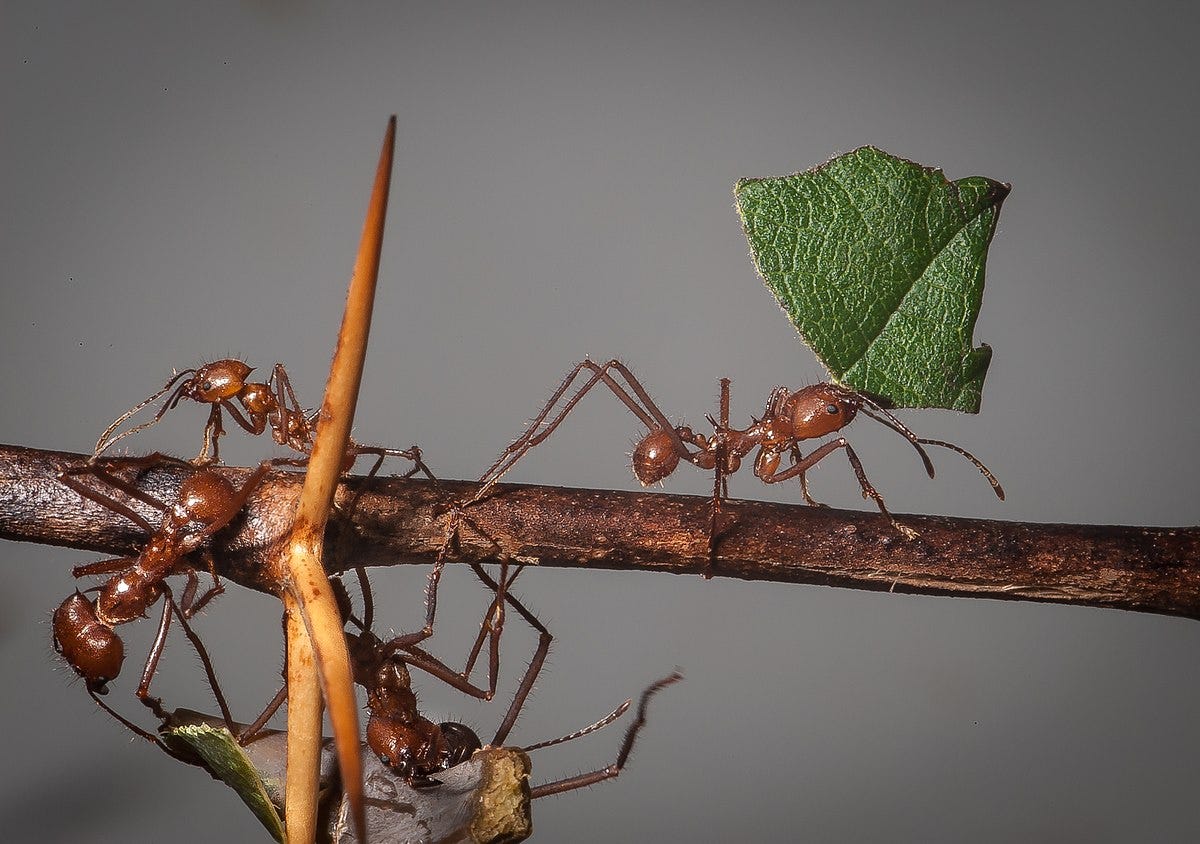
A fungus called Leucoagaricus gongylophorus thrives about five feet under the ground but has its food, the green leaves, home-delivered to itself by leaf-cutting ants, who enjoy an evenly balanced trade relationship with the fungus called obligate mutualism.
Ants are widely known and celebrated as hardworking collectors and hoarders of food, having inspired fables around the persistent and unrelenting labour they put in to that end. But they are also farmers who cultivate their own crops with much the same degree of sophistication as any specialist farmer.
But this is not about all ants and not about all crops.
These are two prominent species of leaf-cutting ants -- Atta cephalotes and Acromyrmex echinatior from the Neotropical region, and are found in the southern United States (like Texas and Louisiana), Central America, and across all countries of South America except Chile. And the crop they carefully cultivate and maintain is a specialist fungus called Leucoagaricus gongylophorus, which produces hyphal swellings to feed the entire colony of its host ants, who regularly and carefully check the health of their crop and take prompt steps as and when something feels amiss.
The relationship between leaf-cutting ants and Leucoagaricus is among the most famous examples of mutualistic symbiosis in the animal kingdom (also referred to as ant-fungus mutualism), with the ants feeding the fungus before the fungus makes extremely nutritious food available for the ants to feed on.
Leucoagaricus gongylophorus (also classified as Leucocoprinus gongylophorus sometimes) is called so because it produces gongylidia, which are specialized, nutrient-rich hyphal swellings that look like small bulbs and are crucial nourishment for the leaf-cutting ants, particularly the young ones, who exclusively consume the gongylidia and cannot survive without them. The same goes for the queen as well. For adult worker ants, it is a significant diet supplement.
Gongylidia: A Specialized Dietary Reward
The fungus produces the nutrient-rich gongylidia almost exclusively for the consumption of its host ants, for it has no real use for them, which is possibly why, when the fungus is grown in a laboratory setting without the presence of ants, it produces them in different shapes and in far lesser quantity than in a natural setting with its usual ant attendants. So, while the fungus does not altogether stop producing gongylidia, it doesn’t seem all that interested in producing them, which indicates that if the ants were not around to tend to it, the fungus would likely face selective pressure to evolve out of producing the bulbs of nutrition.
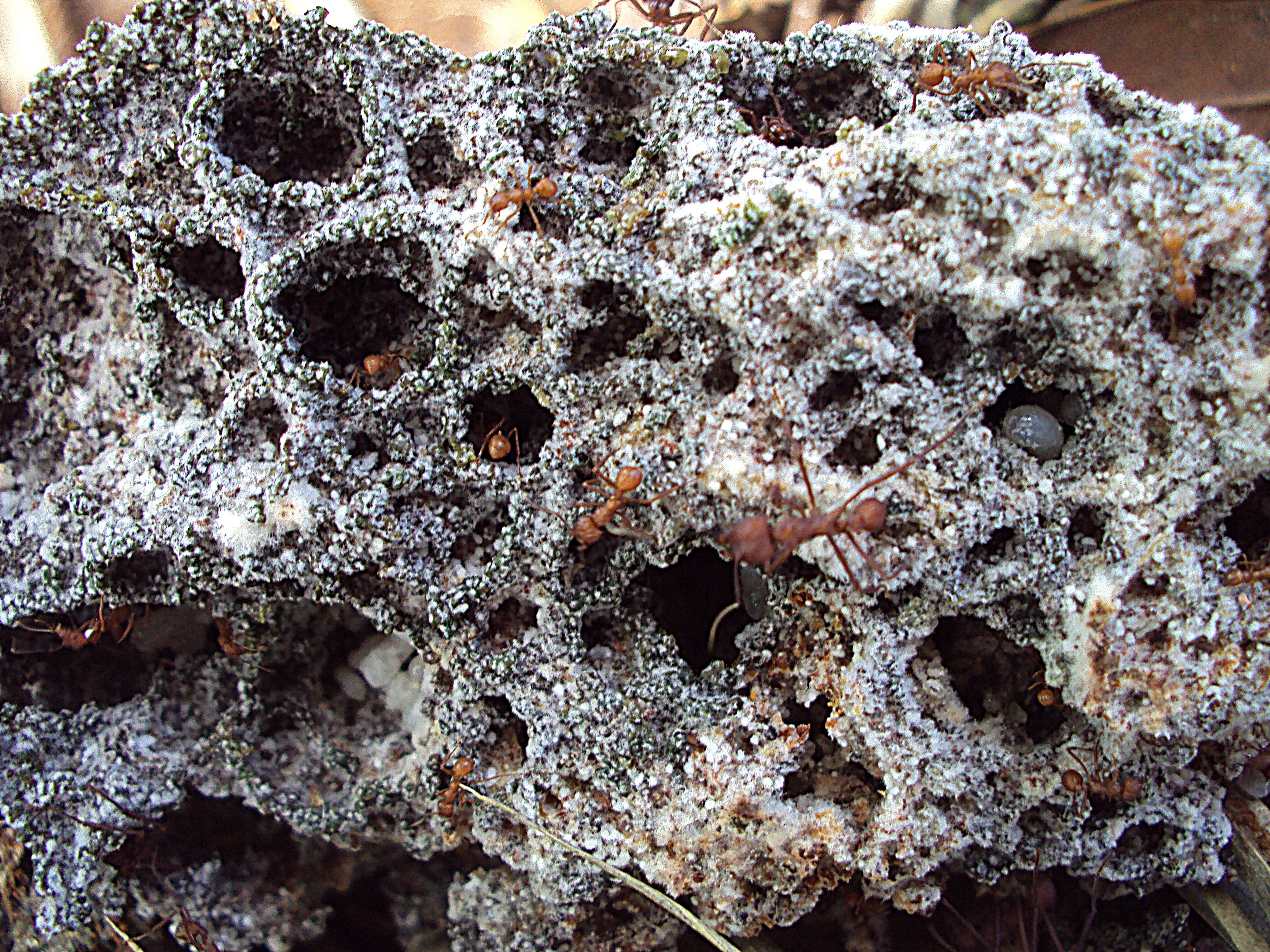
Studies have shown that the fungus uses autophagy, a cellular degradation process, to internally recycle its own cellular contents like cytosol and mitochondria, and then drives the resulting metabolites into the gongylidia vacuole, meaning that this entire process is nothing but a repackaging of its own biomass, which could be for no reason other than to create a readily consumable supply of nutrition for its symbiotic partner, the leaf-cutting ants, for otherwise the fungus does not need to spends energy and resources on the process of re-formulating its own cellular content.
Ants’ External Gut
Leaf-cutting ants need the fungus because they have a gut problem -- they can’t digest the complex carbohydrates, and then there are defensive compounds produced by the leaves, especially lignocellulose, the primary component of plant cell walls.
The fungus acts like an “external gut” for the entire colony of ants, using a varied array of powerful enzymes (lignocellulases, cellulases, etc.) to break down the highly stubborn plant polymers into simple, easily digestible nutrients, like glucose, simple sugars, and fungal biomass. Once the polymers are thus broken down, the fungus ships them neatly packaged to the gongylidia, making them little globules of nutrition to be readily consumed by the ants like compact pills of nutritional supplement. Without the fungus, the ants would basically starve on a sub-optimal diet of fresh leaves with little nutritional value.
Obligate Mutualism
The leaf-cutting ants and the fungus Leucoagaricus gongylophorus stand in a mutually obligate relation, meaning neither can exist without the other. While the ants can’t find sufficiently nutritious food to survive, the fungus cannot reach up to the leaves to get the food they need, which is because they have so depended on ants to get their food that they have lost their ability to procure their own food, and are thus not found at any place where ants aren’t there to keep them alive by constantly tending to them.
Not only do the ants feed the fungus, but also take good care of it with the small worker ants (minims) constantly patrolling their fungal garden, actively removing contaminants such as mould spores, invading fungal gyphae, and removing the waste. The infected parts of the fungus are chewed up and discarded by the ants far off the garden in refuse chambers to keep diseases away.
In addition, the ants house a mutualistic antibiotic-producing bacteria—often Pseudonocardia or Streptomyces—on their bodies, and go around spreading the bacteria across their fungal garden, much like a farmer would spray a pesticide, selectively killing the parasitic moulds (Escovopsis) without harming their own beloved fungus.
Furthermore, ants also ensure that the fungus has the stable and specific microclimate that it needs to thrive by controlling the climate in the underground nest chambers housing the fungus. The worker ants open and close tunnels to regulate air flow, maintaining the ideal temperature and humidity for the optimum fungal growth.
Ants also regularly clear the waste, including spent leaf material and dead nestmates, picking and carrying the waste away to the dedicated, isolated refuse dumps, thus preventing the buildup of dangerous pathogens and toxins near their delicate food source.
The fungus (Leucoagaricus gongylophorus) has been so extensively cultivated by the leaf-cutting ants generation after generation that it no longer produces spores for sexual reproduction, having no use for it any longer, and depends entirely on the ants to propagate.
So, if the fungus is extinct, so would be the ants, and vice versa.
That’s why when a young queen leaves her home nest to start a new colony, she carries a small pellet of the parent colony’s fungal mycelium in a specialized pocket (the infrabuccal pocket) in her mouth to start cultivating the fungus afresh at a different location with what might be called a farmer starter kit. She establishes a new nest and “seeds” the first fungus garden with this pellet, thereby extending the fungal lineage to a different location.
The Fight Back and Delayed Rejection
Leaves are food for the fungus, which turns it into food for the ants, but since the “food” is organic, it does not just lie dormant to be eaten—it fights back with its own chemical arsenal by releasing optimally synthesized toxins. The toxin is not optimized for the carriers but the end consumer—the fungus.
So, when the ants take the toxified leaves to the fungus, the health of the fungus deteriorates rapidly. But since ants diligently attend to the health of their fungal garden, they sense fungal distress quickly and change the food source to the leaves that have thus far found no need to release the anti-fungal toxin into the leaves, the food source for the fungus. This strategy of changing the food source to prevent toxicity is called delayed rejection.
Not only do the ants stop bringing fungus food from the toxic source, but they also remove the damaged or unprocessed leaf material from the fungus garden and dump it at a designated place far away to prevent further harm to their food source. Over time, the ants can also learn to avoid such plant sources that are likely to contain the anti-fungal toxin.
But this does not mean that the avoidance of such toxic plants by the ants is permanent. The ants would periodically test the dangerous leaves for harmful toxins, and once the toxin level drops, the leaves would again be a good food source for their fungus garden until the leaves, in response to the renewed attack, produce and deploy the toxins afresh.
And the battles continue. Neither side wins definitively, but the cycle of life trudges on through an evenly balanced, never-ending, cyclical warfare.